Q 3: A travelling microscope has `20` divisions per `cm` on the main scale while its vernier scale has total `50` divisions and `25` vernier scale divisions are equal to `24` main scale divisions, what is the least count of the travelling microscope?
(a) `0.001cm`
(b) `0.002mm` (c) `0.002cm` (d) `0.005cm`
Answer (c)
Q 4: Given below are two statements : One is labelled as Assertion (A) and other is labelled as Reason (R).
Assertion (A) : Time period of oscillation of a liquid drop depends on surface tension (S), if density of the liquid is `\rho` and radius of the drop is r, then `T=K\sqrt{\rhor^{3}/S^{3/2}}` is dimensionally correct, where K is dimensionless.
Reason (R) : Using dimensional analysis we get R.H.S. having different dimension than that of time period.
In the light of above statements, choose the correct answer from the options given below.
(a) Both (A) and (R) are true and (R) is the correct explanation of (A)
(b) Both (A) and (R) are true but (R) is not the correct explanation of (A)
(c) (A) is true but (R) is false
(d) (A) is false but (R) is true
Answer (d)
Q 5: Consider the efficiency of carnot's engine is given by `\eta=\frac{\alpha\beta}{sin\theta}log_{e}\frac{\beta x}{kT}` , where `\alpha` and `\beta` are constants. If T is temperature, k is Boltzmann constant, `\theta` is angular displacement and x has the dimensions of length. Then, choose the incorrect option :
(a) Dimensions of `\beta` is same as that of force.
(b) Dimensions of `\alpha^{-1}x` is same as that of energy.
(c) Dimensions of `\eta^{-1} sin\theta` is same as that of `\alpha\beta`.
(d) Dimensions of `\alpha` is same as that of `\beta`.
Answer: (d)
Q 6: The dimensions of `(\frac{B^{2}}{\mu_{\circ}})` will be :
(if `\mu_{\circ}` : permeability of free space and `B` : magnetic field)
Q 7: An expression of energy density is given by `u=\frac{\alpha}{\beta}(\frac{\alpha x}{kt})` , where `\alpha,\beta` are constants, `x` is displacement, `k` is Boltzmann constant and `t` is the temperature. The dimensions of `\beta` will be :
Q 8: A torque meter is calibrated to reference standards of mass, length and time each with `5%` accuracy. After calibration, the measured torque with this torque meter will have net accuracy of :
(a) `15%` (b) `25%` (c) `75%` (d) `5%`
Answer (b)
Q 9: In a Vernier Calipers, `10` divisions of Vernier scale is equal to the `9` divisions of main scale. When both jaws of Vernier calipers touch each other, the zero of the Vernier scale is shifted to the left of zero of the main scale and `4^{th}` Vernier scale division exactly coincides with the main scale reading. One main scale division is equal to `1mm`. While measuring diameter of a spherical body, the body is held between two jaws. It is now observed that zero of the Vernier scale lies between `30` and `31` divisions of main scale reading and `6^{th}` Vernier scale division exactly coincides with the main scale reading. The diameter of the spherical body will be :
Q 10: A screw gauge of pitch `0.5mm` is used to measure the diameter of uniform wire of length `6.8cm`, the main scale reading is `1.5mm`and circular scale reading is `7`. The calculated curved surface area of wire to appropriate significant figures is :
[Screw gauge has `50` divisions on its circular scale]
(a) `6.8cm^{2}`
(b) `3.4cm^{2}` (c) `3.9cm^{2}` (d) `2.4cm^{2}`
Answer (b)
Q 11: The maximum error in the measurement of resistance, current and time for which current flows in an electrical circuit are `1%,2%` and `3%` respectively. The maximum percentage error in the detection of the dissipated heat will be :
(a) `2` (b) `4` (c) `6` (d) `8`
Answer (d)
Q 12: If momentum `[P]`, area `[A]` and time `[T]` are taken as fundamental quantities, then the dimensional formula for coefficient of viscosity is :
Q 13: If n main scale divisions coincide with `(n + 1)` vernier scale divisions. The least count of vernier callipers, when each centimetre on the main scale is divided into five equal parts, will be :
(a) `\frac{2}{n+1}mm`
(b) `\frac{5}{n+1}mm`
(c) `\frac{1}{2n}mm`
(d) `\frac{1}{5n}mm`
Answer (a)
Q 14: Identify the pair of physical quantities which have different dimensions:
(a) Wave number and Rydberg's constant
(b) Stress and Coefficient of elasticity
(c)Coercivity and Magnetisation
(d) Specific heat capacity and Latent heat
Answer (d)
Q 15: Identify the pair of physical quantities that have same dimensions:
(a) velocity gradient and decay constant
(b) Wien's constant and Stefan constant
(c) angular frequency and angular momentum
(d) wave number and Avogadro number
Answer (a)
Q 16: If `Z=\frac{A^{2}B^{3}}{C^{4}}` , then the relative error in `Z` will be :
Q 18: An expression for a dimensionless quantity `P` is given by `P=\frac{alpha}{beta}log_{e}(\frac{kt}{\beta x})`; where `\alpha` and `\beta` are constants, `x` is distance; `k` is Boltzmann constant and `t` is the temperature. Then the dimensions of `\alpha` will be :
Q 19: A silver wire has a mass `(0.6\pm0.006) g`, radius `(0.5\pm0.005) mm` and length `(4\pm0.04) cm`. The maximum percentage error in the measurement of its density will be :
(a) `4%` (b) `3%` (c) `6%` (d) `7%`
Answer (a)
Q 20: The SI unit of a physical quantity is pascal-second. The dimensional formula of this quantity will be :
Q 21: A student determined Young's Modulus of elasticity using the formula `Y=\frac{MgL^{3}}{4bd^{3}\delta}` . The value of `g` is taken to be `9.8 ms^{2}`, without any significant error, his observation are as following.
Physical Quantity
Least count of the Equipment used for measurement
Observed value
Mass `(M)`
`1 g`
`2 kg`
Length of bar `(L)`
`1 mm`
`1 m`
Breadth of bar `(b)`
`0.1 mm`
`4 cm`
Thickness of bar `(d)`
`0.01 mm`
`0.4 cm`
Depression `(\delta)`
`0.01 mm`
`5 mm`
Then the fractional error in the measurement of `Y` is :
(a) `0.0083` (b) `0.0155` (c) `0.155` (d) `0.083`
Answer (b)
Q 22: If velocity `[V]`, time `[T]` and force `[F]` are chosen as the base quantities, the dimensions of the mass will be :
Choose the most appropriate answer from the options given below :
(A) (a)-(ii), (b)-(iii), (c) - (iv) (d)-(I)
(B) (a)-(iii), (b)-(ii), (c) - (iv) (d) - (I)
(C) (a)-(iv), (b)-(ii), (c) - (i) (d)-(iii)
(D) (a)-(iii), (b)-(ii), (c) - (i) (d) - (iv)
Answer (B)
Q 28: If `E` and `H` represents the intensity of electric field and magnetising field respectively, then the unit of `E/H` will be :
(a) ohm (b) mho (c) joule (d) newton
Answer (a)
Q 29: Which of the following is not a dimensionless quantity?
(a) Relative magnetic permeability `(\mu_{r})`
(b) power factor
(c) Permeability of free space `(μ_{o})`
(d) Quality factor
Answer (c)
Q 30: If the length of the pendulum in pendulum clock increases by `0.1%`, then the error in time per day is :
(a) `86.4s` (b) `4.32s` (c) `43.2s` (d) `8.64s`
Answer (c)
Q 31: Match List - I with List - II
Choose the most appropriate answer from the options given below :
(A) (a)-(ii), (b)-(iv), (c)-(i), (d)-(iii)
(B) (a)-(ii), (b)-(i), (c)-(iv), (d)-(iii)
(C) (a)-(iii), (b)-(ii), (c)-(iv), (d)-(I)
(D) (a)-(iii), (b)-(i), (c)-(iv), (d)-(ii)
Answer (D)
Q 32: If `E`, `L`, `M` and `G` denote the quantities as energy, angular momentum, mass and constant of gravitation respectively, then the dimensions of `P` in the formula `P = EL^{2}M^{-5}G^{-2}` are :
Q 33: In a Screw Gauge, fifth division of the circular scale coincides with the reference line when the ratchet is closed. There are `50` divisions on the circular scale, and the main scale moves by `0.5 mm` on a complete rotation. For a particular observation the reading on the main scale is `5 mm` and the `20^{th}` division of the circular scale coincides with reference line. Calculate the true reading.
Q 34: A physical quantity 'y' is represented by the formula `y=m^{2}r^{-4}g^{x}l^{-\frac{3}{2}}`
If the percentage errors found in `y, m, r, l` and `g` are `18, 1, 0.5, 4` and `p` respectively, then find the value of `x` and `p`.
(a) `5 and \pm2` (b) `4 and \pm3` (c) `\frac{16}{3} and \pm\frac{3}{2}` (d) `8 and \pm2`
Answer (c)
Q 35: Assertion A : If in five complete rotations of the circular scale, the distance travelled on main scale of the screw gauge is `5 mm` and there are `50` total divisions on circular scale, then least count is `0.001 cm`.
Reason R :
Least Count =
In the light of the above statements, choose the most appropriate answer from the options given below :
(a) is not correct but R is correct.
(b) Both A and R are correct and R is the correct explanation of A.
(c) A is correct but R is not correct.
(d) Both A and R are correct and R is NOT the correct explanation of A.
Answer (a)
Q 36: The force is given in terms of time t and displacement `x` by the equation
`F = A cos Bx + C sin Dt`
The dimensional formula of `\frac{AD}{B}`is :
(a) `[M^{0}LT^{-1}]` (b) `[ML^{2}T^{-3}]`
(c) `[M^{1}L^{1}T^{-2}]` (d) `[M^{2}L^{2}T^{-3}]`
Answer (b)
Q 37: If time `(t)`, velocity `(v)`, and angular momentum `(l)` are taken as the fundamental units. Then the dimension of mass `(m)` in terms of `t`, `v` and `l` is :
Q 38: The vernier scale used for measurement has a positive zero error of `0.2 mm`. If while taking a measurement it was noted that `'0'` on the vernier scale lies between `8.5 cm` and `8.6 cm`, vernier coincidence is `6`, then the correct value of measurement is ___________ `cm`. (least count = `0.01 cm`)
Q 39: In order to determine the Young's Modulus of a wire of radius `0.2 cm` (measured using a scale of least count = `0.001 cm`) and length `1m` (measured using a scale of least count = `1 mm`), a weight of mass `1 kg` (measured using a scale of least count = `1 g`) was hanged to get the elongation of `0.5 cm` (measured using a scale of least count `0.001 cm`). What will be the fractional error in the value of Young's Modulus determined by this experiment?
(a) `.0.14%` (b) `9%` (c) `1.4%` (d) `0.9%`
Answer (c)
Q 40: One main scale division of a vernier callipers is 'a' cm and nth division of the vernier scale coincide with `(n-1)^{th}`th division of the main scale. The least count of the callipers in mm is :
Q 42: In a typical combustion engine the workdone by a gas molecule is given by `W=\alpha^{2}\beta e\frac{-\beta x^{2}}{kT}` , where `x` is the displacement, `k` is the Boltzmann constant and `T` is the temperature. If `\alpha` and `\beta` are constants, dimensions of `\alpha` will be :
Q 43: If e is the electronic charge, `c` is the speed of light in free space and h is Planck's constant, the quantity `\frac{1}{4\pi\varepsilon_{0}}\frac{|e|^{2}}{hc}` has dimensions of :
Q 44: The pitch of the screw gauge is `1 mm` and there are `100` divisions on the circular scale. When nothing is put in between the jaws, the zero of the circular scale lies `8` divisions below the reference line. When a wire is placed between the jaws, the first linear scale division is clearly visible while `72^{nd}` division on circular scale coincides with the reference line. The radius of the wire is :
Choose the correct answer from the options given below :
(A) (a) (ii) ,(b) (iii),(c) (iv),(d) (I)
(B) (a) (i) ,(b) (ii),(c) (iv),(d) (iii)
(C) (a) (iii) ,(b) (ii),(c) (iv),(d) (I)
(D) (a) (iii) ,(b) (iv),(c) (ii),(d) (i)
Answer (A)
Q 46: The period of oscillation of a simple pendulum is `T=2\pi\sqrt{\frac{L}{g}}`. Measured value of `'L'` is 1.0 m from meter scale having a minimum division of `1 mm` and time of one complete oscillation is `1.95 s` measured from stopwatch of `0.01 s` resolution. The percentage error in the determination of `'g'` will be :
(a) `1.30%` (b) `1.33%` (c) `1.13%` (d) `1.03%`
Answer (c)
Q 47: The work done by a gas molecule in an isolated system is given by, `W=\alpha\beta^{2}e-\frac{x^{2}}{\alpha kT}` , where `x` is the displacement, `k` is the Boltzmann constant and `T` is the temperature. `\alpha` and `\beta` are constants. Then the dimensions of `\beta` will be :
Q 48: A student measuring the diameter of a pencil of circular cross-section with the help of a vernier scale records the following four readings `5.50 mm, 5.55 mm, 5.45 mm, 5.65 mm`. The average of these four readings is `5.5375 mm` and the standard deviation of the data is `0.07395 mm`. The average diameter
Q 49: A screw gauge has `50` divisions on its circular scale. The circular scale is `4` units ahead of the pitch scale marking, prior to use. Upon one complete rotation of the circular scale, a displacement of `0.5mm` is noticed on the pitch scale. The nature of zero error involved and the least count of the screw gauge, are respectively :
Q 50: A physical quantity z depends on four observables
`a, b, c` and `d`, as `z =\frac{a^{2}b^{\frac{2}{3}}}{\sqrt{c}d^{3}}` . The percentages of error in the measurement of `a, b, c` and `d` are `2%, 1.5%, 4%` and `2.5%` respectively. The percentage of error in `z` is :
(a) `13.5%` (b) `14.5%` (c) `16.5%` (d) `12.25%`
Answer (b)
Q 51: A quantity `x` is given by `(\frac{IFu^{2}}{WL^{4}})` in terms of moment of inertia `I`, force `F`, velocity `v`, work `W` and `L`ength `L`. The dimensional formula for `x` is same as that of :
(a) Coefficient of visoscity (b) Force constant (c) Energy density (d) Planck's constant
Answer (c)
Q 52: Dimensional formula for thermal conductivity is (here `K` denotes the temperature):
Q 54: Using screw gauge of pitch `0.1 cm` and `50` divisions on its circular scale, the thickness of an object is measured. It should correctly be recorded as
Answer (a) Q 57: The least count of the main scale of a vernier callipers is `1 mm`. Its vernier scale is divided into `10` divisions and coincide with `9` divisions of the main scale. When jaws are touching each other, the `7^{th}` division of vernier scale coincides with a division of main scale and the zero of vernier scale is lying right side of the zero of main scale. When this vernier is used to measure length of a cylinder the zero of the vernier scale between `3.1 cm` and `3.2 cm` and `4^{th}` `VSD` coincides with a main scale division. The length of the cylinder is : (`VSD` is vernier scale division)
Q 59: If the screw on a screw-gauge is given six rotations, it moves by `3 mm` on the main scale. If there are `50` divisions on the circular scale the least count of the screw gauge is :
Q 60: A quantity f is given by `f=\sqrt{\frac{hc^{5}}{G}}` where c is speed of light, `G` universal gravitational constant and h is the Planck's constant. Dimension of f is that of :
(a) Energy (b) Momentum (c) Area (d) Voluem
Answer (a)
Q 61:The dimension of stopping potential `V_{0}` in photoelectric effect in units of Planck's constant `'h'`, speed of light `'c'` and Gravitational constant `'G'` and ampere `A` is :
`(A) h^{1/3} G^{2/3} c^{1/3} A^{-1}`
`(B) h^{o} c^{5} G^{-1} A^{-1}`
`(C) h^{2/3} c^{5/3} G^{1/3} A^{-1}`
`(D) h^{2} G^{3/2} c^{1/3} A^{-1}`
Answer (B)
Q 62: The dimension of `\frac{B^{2}}{2\mu_{0}}` , where `B` is magnetic field and `\mu_{0}` is the magnetic permeability of vacuum, is :
JULY-2022 Q 63: In an experiment to find acceleration due to gravity (g) using simple pendulum, time period of `0.5s`is measured from time of 100 oscillation with a watch of `1s` resolution. If measured value of length is `10cm` known to `1mm` accuracy, The accuracy in the determination of `g` is found to be `x%` . The value of `x` is ___________.
Answer: `5` Q 64: The one division of main scale of Vernier callipers reads `1mm`and `10` divisions of Vernier scale is equal to the `9` divisions on main scale. When the two jaws of the instrument touch each other, the zero of the Vernier lies to the right of zero of the main scale and its fourth division coincides with a main scale division. When a spherical bob is tightly placed between the two jaws, the zero of the Vernier scale lies in between `4.1cm` and `4.2cm` and `6^{th}` Vernier division coincides scale division. The diameter of the bob will be ____________ `\times10^{-2} cm`.
Answer: `412`
Q 66: For `z=a^{2}x^{3}y^{1/2}`, where `'a'` is a constant. If percentage error in measurement of `'x'` and `'y'` are `4%` and `12%` respectively, then the percentage error for `'z'` will be _______________`%.`
Answer: `18`
JUNE-2022
Q 67: A travelling microscope is used to determine the refractive index of a glass slab. If `40` divisions are there in `1 cm` on main scale and `50` Vernier scale divisions are equal to `49` main scale divisions, then least count of the travelling microscope is __________ `\times10^{-6} m`.
Answer: `5`
Q 68: In a vernier callipers, each cm on the main scale is divided into `20` equal parts. If tenth vernier scale division coincides with nineth main scale division. Then the value of vernier constant will be _________ `\times10^{-2} mm`.
Answer: `5`
Q 69: A student in the laboratory measures thickness of a wire using screw gauge. The readings are `1.22 mm, 1.23 mm, 1.19 mm and 1.20 mm`. The percentage error is `\frac{x}{121}%` . The value of `x` is ____________.
Answer: `150`
Q 70: The Vernier constant of Vernier callipers is `0.1 mm` and it has zero error of `(-0.05) cm`. While measuring diameter of a sphere, the main scale reading is `1.7 cm` and coinciding vernier division is `5`. The corrected diameter will be _________ `\times10^{-2} cm`.
Answer: `180`
AUG-2021
Q 71: The diameter of a spherical bob is measured using a vernier callipers. `9` divisions of the main scale, in the vernier callipers, are equal to `10` divisions of vernier scale. One main scale division is `1 mm`. The main scale reading is `10 mm` and `8^{th}` division of vernier scale was found to coincide exactly with one of the main scale division. If the given vernier callipers has positive zero error of `0.04 cm`, then the radius of the bob is ___________`\times10^{-2} cm`.
Answer: `52`
Q 72: The acceleration due to gravity is found upto an accuracy of `4%` on a planet. The energy supplied to a simple pendulum to known mass 'm' to undertake oscillations of time period T is being estimated. If time period is measured to an accuracy of `3%`, the accuracy to which `E` is known as ..............`%`
Answer: `14`
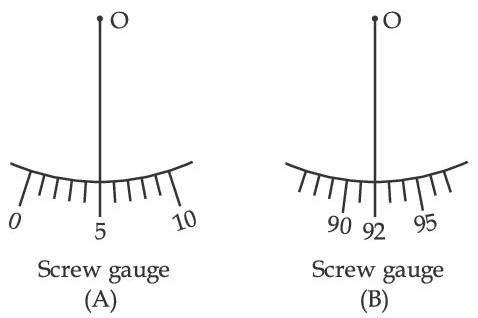
Q 74: Student `A` and student `B` used two screw gauges of equal pitch and `100` equal circular divisions to measure the radius of a given wire. The actual value of the radius of the wire is `0.322 cm`. The absolute value of the difference between the final circular scale readings observed by the students `A` and `B` is ______________.
[Figure shows position of reference `'O'` when jaws of screw gauge are closed] Given pitch `= 0.1 cm`.
Answer: `13`
Q 75: Three students `S_{1}, S_{2}` and `S_{3}` perform an experiment for determining the acceleration due to gravity (g) using a simple pendulum. They use different lengths of pendulum and record time for different number of oscillations. The observations are as shown in the table.
Student No.
Length of Pendulum (cm)
No. of oscillations (n)
Total time for n oscillations
Time period (s)
1
64.0
8
128.0
16.0
2
64.0
4
64.0
16.0
3
20.0
4
36.0
9.0
(Least count of length = `0.1 cm` and Least count for time = `0.1 s`) If `E_{1}, E_{2}` and `E_{3}` are the percentage errors in `'g'` for students `1, 2` and `3` respectively, then the minimum percentage error is obtained by student no. ______________.
Answer: `1`
Q 76: The radius of a sphere is measured to be `(7.50\pm0.85) cm`. Suppose the percentage error in its volume is `x`.
The value of `x`, to the nearest `x`, is __________.
Answer: `34`
Q 77: The resistance `R =\frac{V}{I}` , where `V = (50\pm2)V` and `I = (20\pm0.2)A`. The percentage error in R is `'x'%`. The value of `'x'` to the nearest integer is _________.
Answer: `5`
Q 78: The density of a solid metal sphere is determined by measuring its mass and its diameter. The maximum error in the density of the sphere is `(\frac{x}{100})%`. If the relative errors in measuring the mass and the diameter are `6.0%` and `1.5%` respectively, the value of `x` is_______.


Comments
Post a Comment